Eugène Ionesco:
Art is useless, but it is an indispensable uselessness. Art is style, not what is said, but how it is stated.
The writer is not contained within his time, not restricted by age. The writer and artist go beyond their time. The critic is restricted by the age. Art since the beginning of time, to survive, as in Bread and Circuses.
Art is different from ideology and politics that separate us. Art unites us.
Eugène Ionesco:
I don’t write for an audience, in particular; concepts and types, such as the intellectual bourgeoisie we are everywhere, yet affecting exclusivity.
Eugène Ionesco:
A center for all people, for all arts, such as the Pompidou, is necessary and vital, to sustain art that is non-exclusive, invites all responses.
Eugène Ionesco:
The meaning of the play evolves; yet, there is something which remains the same unto itself, to which the audience responds universality. An example is his Rhinoceros, which performed now before young audiences, might be regarded as a reference to the Nazis. When first performed in Spain it was considered anti-Stalin. In Argentina, performed after the fall of Peron, it was considered Anti-Peron.
In America critics thought it to be anti-conformist.
Eugène Ionesco:
A fundamental meaning transcends all interpretation such as:
The Horror of the Crowd, Sickness of Personality, Fanaticism.
These meanings, like always, a danger today.
DISCUSSION OF THE BALD SOPRANO
Eugène Ionesco:
I conceived of the characters as both:Real People and Stage Mouthpieces.
Eugène Ionesco:
I considered titling it: Anti-Play or Tragedy of Language.
I wanted to de-signify the language, to express words as emptily and banally as possible, to achieve an emptying out of language, to put people back in reality in a more conscious and active way.
Eugène Ionesco:
The Bald Soprano is a criticism of people who speak, in order to. Say nothing; a criticism of our trivialities and commonplaces. It is non-figurative, nontraditional, to realize an abstract structure; yet is remains a play in the sense of a game.
FUNDAMENTAL TO LIFE AND ART
Eugène Ionesco:
Fundamental to life and art:
The live to fight, destroy others, and oneself:
The satisfaction of needs such as eating, sleeping, and play.
When we don’t kill anymore, we play. This is art.
Maison Française Critics site Ionesco as central to Theater of the Absurd; although, this may not be Ionesco’s consideration of his work.
Eugène Ionesco:
[ NO.]Because the world is absurd, the tragic and cruel absurdity of which we should laugh, while crying is reflected. The absurd was detected by all writers of all ages. Shakespeare had Macbeth say that The world is a story told by an idiot. I’m sure an idiot can do it better than I.
Eugène Ionesco:
To dare to think against everyone is most difficult. The individual in his isolation is precisely the one who reaches universality. Charity is more powerful than justice; for justice means punishment.
Marxist Critics, who are no longer Marxists, poison with dogmatism. They want those criticized to create a better society, strictly in their own terms.
Eugène Ionesco:
THERE IS ALWAYS A PLAY IN THE MAKING WHICH DOES NOT QUITE GET COMPLETED, SO I WRITE ANOTHER
Eugène Ionesco:
The absurd reflects the fact that there is an inconsistency by which creation and man are incompatible. We feel cheated by this inconsistency. That is why societies are virtually the same.
I consciously write plays on these problems; for now, Exit the King expresses his anguishes, which reflect and direct all of mankind’s anguishes; therefore if he criticizes society, it is really a criticism of all societies and himself.
Eugène Ionesco:
Politics divide us and anguishes unite us. For example, the deep significance of our revolutions is very different from what the ideologies of the revolutions lead us to believe. Revolutions are revolts against creation. Our angry incompatibility.
Eugène Ionesco:
Not to write, is sometimes to write.The deepest influences are more difficult to detect by the author himself. When his plays begin again at the end it is an Enactment of the Infernal Cycle.
All societies, up to the present, get worse when you try to improve them, to make them better, by providing easy to think and act ends up killing.
Eugène Ionesco:
Right now the arts have little hope for renewal because what is going on in the world is so anguishing that man doesn’t wish to play. Time is needed for things to settle, too many experiments. Documentation in art is false. Reality is not realism, realism is convention.
Eugène Ionesco:
What would renew the arts — A Non-Realistic Theater. Truth rests in the imagination. The imaginary world cannot lie. The lies reveal the poet.
Eugène Ionesco:
I never really liked the theater.
My first plays were against plays.
I read mostly the newspapers.
Eugène Ionesco:
I like the playwright Robert Wilson who is popular in France. The audience must find the truth, and must not forget their archetypes, and must feel anguish in logic.
We who hate each other because they hate the shape in which they find themselves; such as, an Agnostic who says that God did not create the universe, it was created by angels or devils who stole secrets from God.
Above all, my plays are theater; and theater, I believe, excuses of any ambiguities, and changes of mind about the what our discussion.
Eugène Ionesco:
Thank you for your attention and thanked the audience for their attention and questions because it had helped me understand myself and my works.
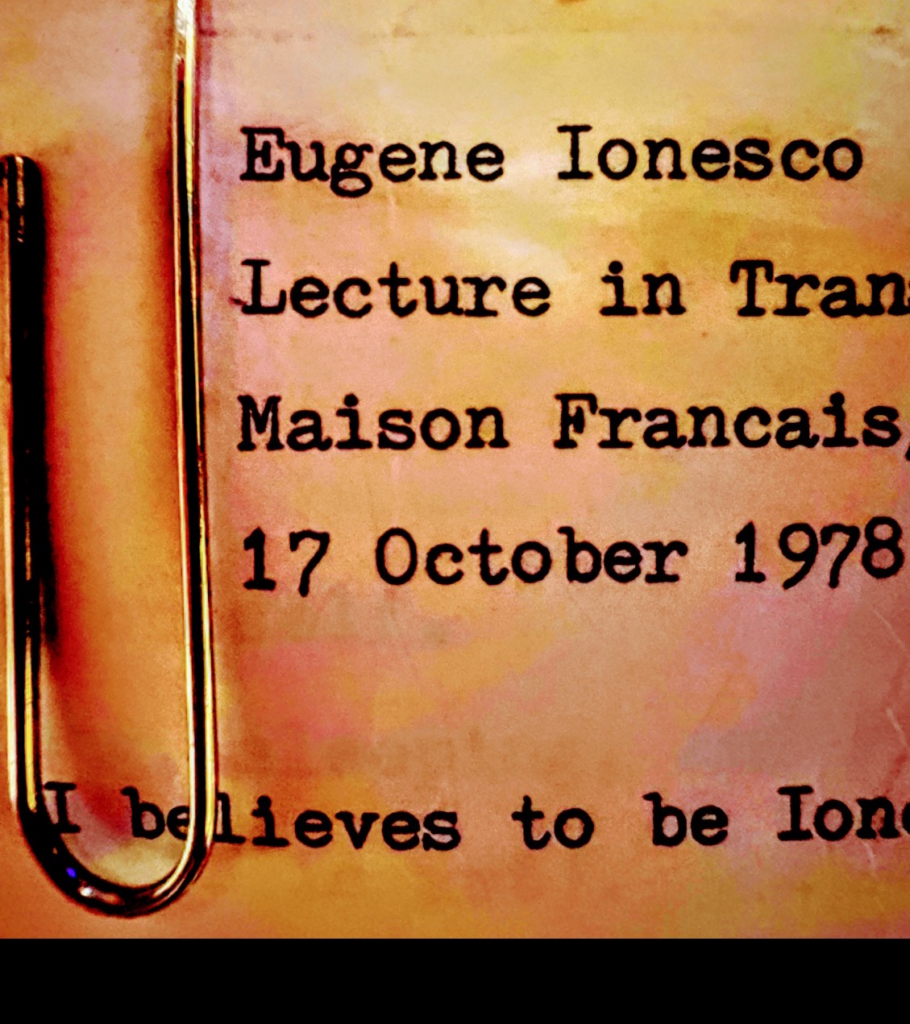
*N.W. Lecture notes, typed and ready, Oct 17,1978 sending to the only press that will honor the request made of me: None may represent as within The Absurdist Theater. Thank you, Sentenced Lit.